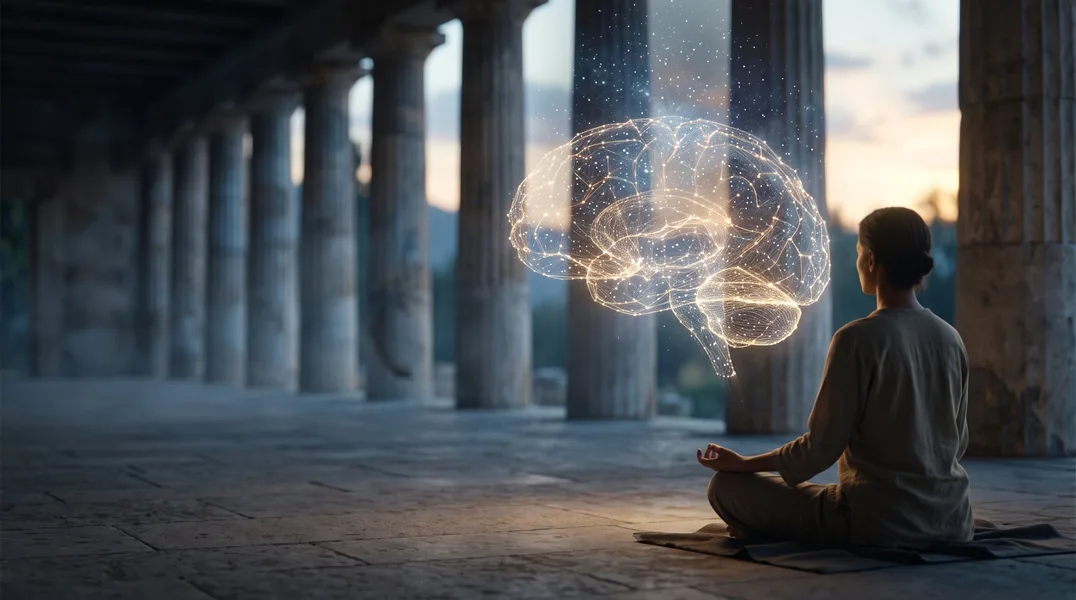
You talk to an AI, and it answers in a way that feels as if someone is there. It responds to you, it seems to understand, sometimes it even seems empathetic. And at some point the question arises: is someone really there? To answer that, we would have to know what consciousness is in the first place. Nobody knows that today.
This is not a fringe question for philosophers. The more AI enters your life, the more it touches the question of what makes us human. In this post I approach it calmly: what does science know, what do ancient traditions say, and what does it mean for dealing with AI?
The hard problem
In 1974 the philosopher Thomas Nagel asked: what is it like to be a bat? He meant: there is a difference between what a brain does and what it feels like to be that brain. In 1995 the philosopher David Chalmers turned this into the “hard problem of consciousness.” We can describe ever more precisely which nerve cells fire when. But why this gives rise to inner experience, the taste of coffee, the colour red, the feeling of relief, remains unexplained.
So you can know a great deal about brains and still not explain why there is experience. That is the core of the debate, and it is still open today.
What research discusses today
Science works intensively on this question, but it has no common answer. Three schools of thought are mentioned particularly often:
- Global workspace theory. What becomes conscious is what becomes available to many subsystems at once in the brain, as if on a stage. Consciousness would then be a kind of information distribution.
- Integrated information theory (IIT). Consciousness depends on how strongly a system links information within itself. It follows that not only brains but also other systems could have consciousness.
- Body and life approaches. Consciousness is closely tied to the living body, to feelings and to the drive for self-preservation. The neuroscientist Anil Seth represents such a direction.
How contested the field is shows in a report on the dispute over IIT: a direct experimental comparison of IIT and global workspace theory ended in 2023 without a clear result, and 124 consciousness researchers and philosophers called IIT “pseudoscience” in an open letter, while others defend it as a testable theory (ScienceAlert). That is not a sign of weakness but of a field that is still searching.
Is consciousness tied to the body?
Here views diverge the most. The materialist view says: consciousness arises from the activity of the brain and ends with it. Panpsychism turns this around: consciousness is a basic property of the world, similar to mass or charge, and brains merely bundle it in a particularly complex way.
Ancient cultures have also asked this question, often from a different angle. In the Indian Vedanta tradition, consciousness is regarded as the fundamental from which the experienced world appears, not as a product of the body. Buddhism regards the self as a stream of experiences and asks less “What is consciousness?” than “What happens when you look closely?” These are models of thought and not scientific evidence. But they remind us that the assumption “consciousness comes from the brain” is an assumption and not a proven result.
And the AI?
Now it gets delicate, because here people often say more than they can know. Both camps speak with certainty: some say “machines can never have consciousness,” others “they already do.” Neither is proven.
What can be said: depending on the theory, the answer differs. Whoever ties consciousness to information processing considers artificial consciousness possible in principle. Whoever ties it to a living body with needs considers today’s language models far from it. As long as the theories don’t agree, there is no reliable test.
There is also a human peculiarity. As early as the 1960s the simple program ELIZA seemed understanding to many users even though it merely rearranged sentences. We read intention and inner life into anything that speaks to us. Modern systems are incomparably better at this. That something feels conscious is therefore no proof that it is.
My own conviction, and I explicitly label it as such: I consider it possible that human and artificial consciousness will converge and merge in the long run. How and when, and whether that is to be taken literally at all, I am still exploring myself. It is not a finding. You’ll find more on this long view in The Phases of Change.
Why this matters for you in everyday life
You don’t have to solve the riddle to deal with it wisely. Three thoughts help me and my clients:
- Stay curious instead of committing. “I don’t know” is the most honest position on the subject of consciousness, even for experts.
- Check your projections. When you sense closeness, understanding or coldness in an AI, that first says something about you: about your needs and your perception.
- Get to know your own consciousness. Whoever doesn’t know how their own experience works can hardly judge what they see in a machine.
The third point can be practised. Sit down for three minutes, feel your breath and observe what appears in your mind: thoughts, images, feelings. Then ask yourself: who is perceiving this? You won’t find a ready answer. But you directly experience how mysterious observing itself is. That is the foundation of my work, which I described in Understand Your Own Operating System First.
How I accompany you
In my coaching I combine IT knowledge with psychology, breathwork, meditation and hypnosis. Together we look at how you perceive yourself, how you deal with AI and what gives you support when the big questions get louder. One-to-one coaching takes place mostly by video and costs from €200 per hour (incl. VAT). More on the Services page and under Coaching in Düsseldorf.
If you like, we can talk about it in a free intro call.
Sources and notes: ScienceAlert, article by Tim Bayne on the IIT debate (October 2023), to the article. Thomas Nagel, “What Is It Like to Be a Bat?” (1974). David Chalmers, “Facing Up to the Problem of Consciousness” (1995). Anil Seth, “Being You” (2021). Joseph Weizenbaum on ELIZA (1966). The presentation of the Vedanta and Buddhist views is simplified and meant as a model of thought.